
On June 25, 2023, I left my cramped Jackson, Wyoming, hotel room in the pale, pre-dawn light and headed north on Wyoming Highway 26. I wanted to beat the crowds which, just after sunrise every day, surge into the beautiful valley yonder and, hopefully, have a little time with the land to myself. I was clear of town limits ahead of the masses and, before long, the golden light expanding from the east was chasing shadows from the crags and jagged peaks of the mighty Grand Tetons. A pair of leggy moose traversed knee-high grasses through a meadow parallel to the highway as I inched along watching them. It was glorious, and I would be hard-pressed to think of a better way to begin the day anywhere in the world.
My trip north was ultimately a journey home to Missoula after having been on the road a couple of weeks, and my meandering route would include a visit to the Old Faithful area of Yellowstone National Park. That particular region isn’t necessarily my favorite part of the park – I’m a Lamar Valley guy – but I wanted to visit my friend Alyssa McGeeley (Muscogee/Creek) at the Yellowstone Tribal Heritage Center. Alyssa was, at the time, the Tribal Center Coordinator for Yellowstone Forever, and I’d not yet seen the Center. When she knew I’d be passing through the park on my return from a book festival in Jackson Hole, she urged me to stop and say hello.
by Chris La Tray
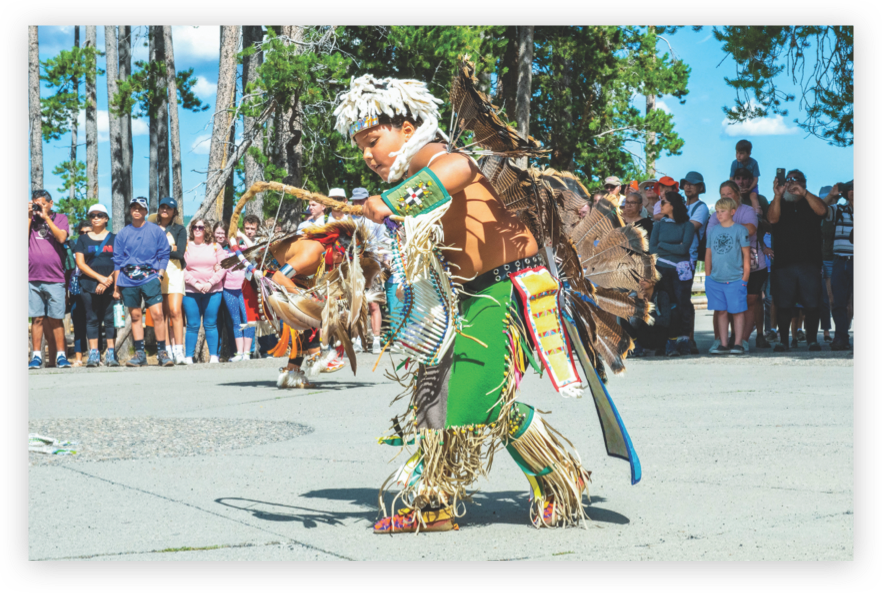
tacia Morfin - Nez Perce (3) | PHOTO COURTESY OF YELLOWSTONE FOREVER / ALYSSA MCGEELY
The Yellowstone Tribal Heritage Center, founded in 2022 as part of Yellowstone’s effort to “re-Indigenize” the park in the wake of its 150-year anniversary, is managed by Yellowstone Forever (YF), the park’s official nonprofit partner, in partnership with the National Park Service and Tribal consultation. In the first 150 years of YNP’s existence, Indigenous presence has largely been erased, and it is time to change that. The Center’s purpose to celebrate Indigenous artists, scholars, and presenters, and give them an opportunity to meet face-to-face with visitors, is a giant first step. Prior to my trip to Jackson, I participated in a meeting between YF, Park Service employees, and a couple dozen Native folks to discuss exactly what a re-Indigenization might look like. Headed home, though there is still so much work to be done against the broader effort, I was eager to experience the vibe of this transformative energy. I wasn’t disappointed.
Not that familiar with the expanding footprint of the Old Faithful area, the center took some finding. I arrived early, waited for a store near the Old Faithful Lodge to open so I could get more coffee, then wandered across the parking lot. Cars were already beginning to stack up in the lot and I was pleased to make conversation with several of the large, stunningly black ravens – gaagaagiwag in the Anishinaabemowin of my Little Shell people – who frequent the area. I stood and watched with delight as one of them patiently worked at the zipper of a bag attached to the front handlebars of a mountain bike in the back of an oversized pickup. I am never not amazed at the displays of intelligence these relatives regularly share with me.
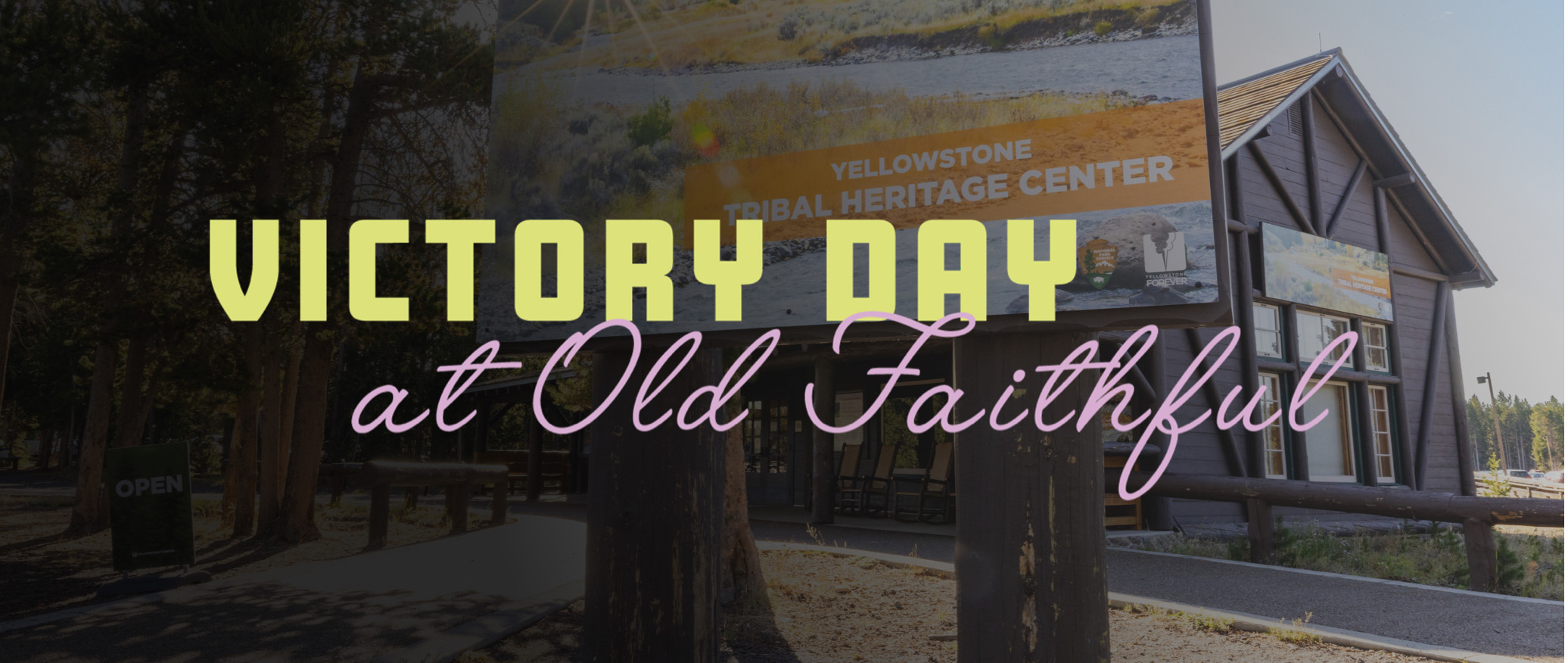
I found the Tribal Heritage Center located just between the Old Faithful Visitor Education Center and the Old Faithful Lodge, the famous geyser just yonder. The building was a little larger than I expected, and, when I entered the front door, Alyssa was inside and bustling about, preparing for the day’s wave of tourist visitors. We hugged it out and then she showed me around. To the left of the entrance is a gift shop; they sell cards and art prints and books and other things you might expect. But to the right is a decently sized room for that week’s visiting artist-in-residence.
“You’re just in time,” Alyssa told me. “Kelly just got set up. I’ll introduce you.”
Every week during the summer features a different artist in residence. Kelly Lookinghorse, in residence during my first visit, is an Oglala Lakota elder who, along with his wife Suzie, makes many things such as beaded moccasins, medicine bags, dream catchers, and, of particular interest on this day, drums. Their wares were displayed on racks and stands all around the room. Suzie, smiling and gregarious (she’s “a California Indian!” Kelly would later tell me, assuming this would explain her demeanor), stood behind a table and handled all the commerce. She gave me a pack of cards she said she’d brought from the casino near the encampment at Standing Rock when they’d been there in solidarity with the Water Protectors. They are in my desk at home, my go-to deck for bare knuckle games of solitaire waged against myself.
I found the Tribal Heritage Center located just between the Old Faithful Visitor Education Center and the Old Faithful Lodge, the famous geyser just yonder. The building was a little larger than I expected, and, when I entered the front door, Alyssa was inside and bustling about, preparing for the day’s wave of tourist visitors. We hugged it out and then she showed me around. To the left of the entrance is a gift shop; they sell cards and art prints and books and other things you might expect. But to the right is a decently sized room for that week’s visiting artist-in-residence.
“You’re just in time,” Alyssa told me. “Kelly just got set up. I’ll introduce you.”
Every week during the summer features a different artist in residence. Kelly Lookinghorse, in residence during my first visit, is an Oglala Lakota elder who, along with his wife Suzie, makes many things such as beaded moccasins, medicine bags, dream catchers, and, of particular interest on this day, drums. Their wares were displayed on racks and stands all around the room. Suzie, smiling and gregarious (she’s “a California Indian!” Kelly would later tell me, assuming this would explain her demeanor), stood behind a table and handled all the commerce. She gave me a pack of cards she said she’d brought from the casino near the encampment at Standing Rock when they’d been there in solidarity with the Water Protectors. They are in my desk at home, my go-to deck for bare knuckle games of solitaire waged against myself.
When Alyssa introduced Kelly and me – Kelly, a large man in a T-shirt with a lined face and a quick grin, was sitting on a folding metal chair beside a large drum – we shook hands. He gestured to an identical chair beside him, and I sat down. Kelly told me that this was the first time he was away from his home in Pine Ridge on this particular date in many years, and that he was missing being among his people for Victory Day. Startled, I realized that this very day was the 147th anniversary of the Battle of the Little Bighorn, or the Battle of the Greasy Grass, that went down over the two days of June 25 and 26, not so far from where we were seated, in 1876. This conflict, of course, was when a combined camp of Lakota, Northern Cheyenne, and Arapaho people wiped out the entire 7th Cavalry under the leadership of George Armstrong Custer. It was a glorious and significant victory for the tribes, one still celebrated annually by the Indigenous people involved, many only a couple generations removed from those who fought in it. The reverberations of that battle still linger in tribal communities today in varied and significant ways. It is as important a day as any celebrated in this part of the world.
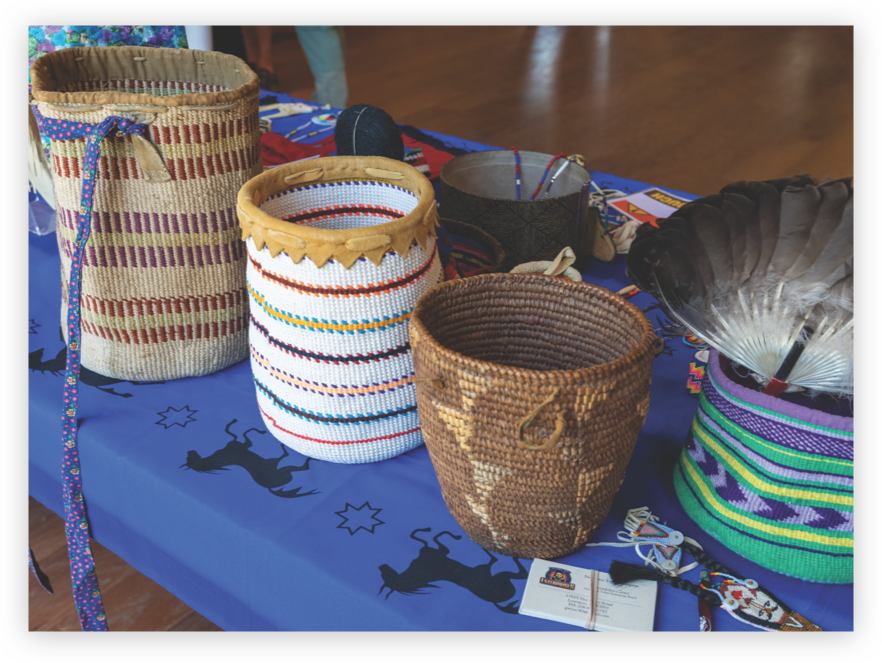
Nimipuu (Nez Perce) traditional twining bags and cedar basket displayed by Gwen Carter | PHOTO COURTESY OF YELLOWSTONE FOREVER / ALYSSA MCGEELY:
Kelly went on by telling me about the drum he was sitting beside. It was large and round, perhaps three feet in diameter. A “big powwow drum,” as he called it, that he had made himself. The cottonwood shell was made from a deadfall tree on his land, and the stretched buffalo skin drumhead was from a bison who had given himself to Kelly’s rifle. The drum was beautiful.
“I’ve never played it before,” Kelly said, thumping it softly with his thumb. The drum’s voice in response was deep and stirring. “Would you like to join me in playing it, and I will sing the Victory Song?” I was stunned. Of course I said yes. I’d never been invited to play for such a significant moment before myself, and to do so on this day with an elder from the community directly impacted by that bloody day more than a century-and-a-half ago was an honor I did not take lightly. Kelly produced some sage and introduced it to fire; we smudged ourselves in the purifying smoke, then he smudged the drum. Dewe’igan is the word for drum in Anishinaabemowin and means “the one who makes the sound of the heart.” Mine was thumping before we even began.
While Kelly sang and played, I followed his lead. It was an experience that I will carry with me for the rest of my life. I didn’t know the words, but I felt them, tears rolling down my cheeks. It seemed to last forever while also ending far too soon. When we finished there was a deep pause, then I thanked Kelly for the experience. I didn’t have words to express how I felt.
“I’ve never played it before,” Kelly said, thumping it softly with his thumb. The drum’s voice in response was deep and stirring. “Would you like to join me in playing it, and I will sing the Victory Song?” I was stunned. Of course I said yes. I’d never been invited to play for such a significant moment before myself, and to do so on this day with an elder from the community directly impacted by that bloody day more than a century-and-a-half ago was an honor I did not take lightly. Kelly produced some sage and introduced it to fire; we smudged ourselves in the purifying smoke, then he smudged the drum. Dewe’igan is the word for drum in Anishinaabemowin and means “the one who makes the sound of the heart.” Mine was thumping before we even began.
While Kelly sang and played, I followed his lead. It was an experience that I will carry with me for the rest of my life. I didn’t know the words, but I felt them, tears rolling down my cheeks. It seemed to last forever while also ending far too soon. When we finished there was a deep pause, then I thanked Kelly for the experience. I didn’t have words to express how I felt.
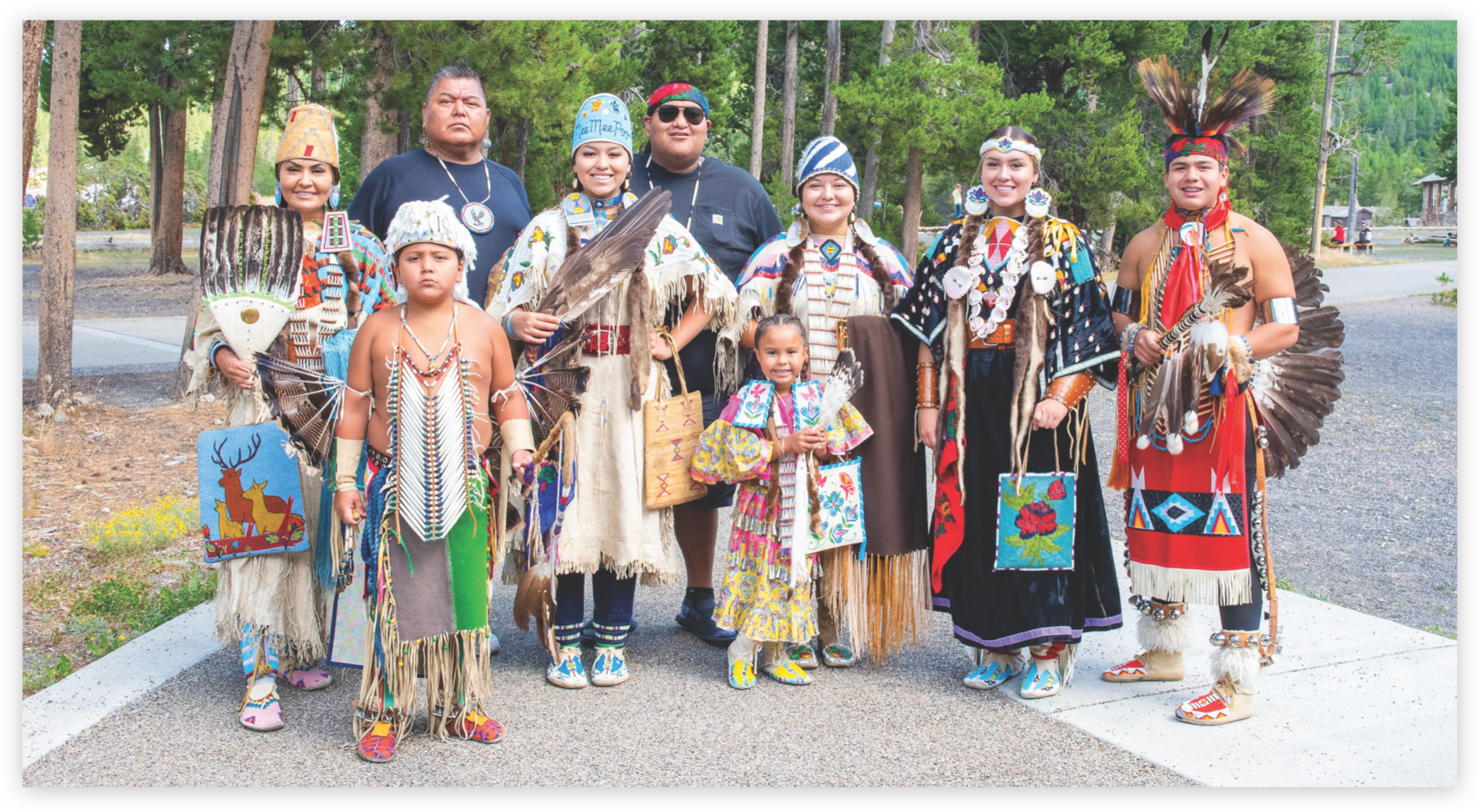
tacia Morfin - Nez Perce | PHOTO COURTESY OF YELLOWSTONE FOREVER / ALYSSA MCGEELY:
This kind of interaction is important. While not everyone will have the unique experience I did – the Center wasn’t even technically open, so the song was experienced by only a group of five or six of us present – anyone who visits will have an experience of some kind. Kelly, for example, invites visitors to play the drum with him whenever the mood takes him, and it does often. This can be life changing, and the transformation of heart and spirit that may result is an example of “re-Indigenization” that cannot be understated. I left that afternoon after too short of a visit enthusiastic about the steps that are already being taken inside Yellowstone National Park to remind people of the existence of inhabitants who have always been there. The Land herself knows what is going on too and is a mighty and eager participant in the process of inviting us home.
Two years later, the Tribal Heritage Center is going strong. Alyssa, now YF’s Tribal Engagement Manager, is still involved though not in the day-to-day labor of running the Center. That position was handled by my ebullient and energetic friend Georgeline, or “George,” Morsette (Chippewa Cree). This past summer in 2025, from May to October, the Center featured more than twenty-five different artists representing more than a dozen of the twenty-seven associated Tribes recognized by Yellowstone National Park as having a traditional relationship with the region. These folks represented Native creativity in myriad ways, from beading and painting to storytelling, fashion, and language. Kelly Lookinghorse was back, though I missed his visit. When I was there in mid-August, I was able to meet Jim Trueax, one of my Little Shell tribal relatives who is a fabulous painter. The most enjoyable part of the visit was watching Jim interact with visitors from all over the world. The experience was stirring.
The Tribal Heritage Center is a beautiful and necessary presence in the park and I’m grateful for its existence. It is only a beginning, though. I like to imagine something additional and bigger, something located somewhere different from the commercialization of the area around Old Faithful that feels a little gross. What if there was a large visitors center somewhere that is interactive and tells more of the story of all the tribes who were participants in the creation of life in what we now call Yellowstone? And, somewhere else, a year-round teepee encampment? The possibilities of what could be done are myriad and exciting. More than just changing a few place names, I would love to see Native presence threaded through the Yellowstone experience of every visitor throughout the park, not just a single installation one might miss if they looked the wrong direction. The game will be long and wonderful to behold.
Two years later, the Tribal Heritage Center is going strong. Alyssa, now YF’s Tribal Engagement Manager, is still involved though not in the day-to-day labor of running the Center. That position was handled by my ebullient and energetic friend Georgeline, or “George,” Morsette (Chippewa Cree). This past summer in 2025, from May to October, the Center featured more than twenty-five different artists representing more than a dozen of the twenty-seven associated Tribes recognized by Yellowstone National Park as having a traditional relationship with the region. These folks represented Native creativity in myriad ways, from beading and painting to storytelling, fashion, and language. Kelly Lookinghorse was back, though I missed his visit. When I was there in mid-August, I was able to meet Jim Trueax, one of my Little Shell tribal relatives who is a fabulous painter. The most enjoyable part of the visit was watching Jim interact with visitors from all over the world. The experience was stirring.
The Tribal Heritage Center is a beautiful and necessary presence in the park and I’m grateful for its existence. It is only a beginning, though. I like to imagine something additional and bigger, something located somewhere different from the commercialization of the area around Old Faithful that feels a little gross. What if there was a large visitors center somewhere that is interactive and tells more of the story of all the tribes who were participants in the creation of life in what we now call Yellowstone? And, somewhere else, a year-round teepee encampment? The possibilities of what could be done are myriad and exciting. More than just changing a few place names, I would love to see Native presence threaded through the Yellowstone experience of every visitor throughout the park, not just a single installation one might miss if they looked the wrong direction. The game will be long and wonderful to behold.