
Before European colonization of the West, the grizzly bear roamed from Alaska all the way into Mexico. But the new settlers feared grizzlies, systematically killing them until the last survivors were confined to remote parts of the Northern Rockies—just two percent of their former range in the Lower 48 states. Biologists began to worry about the bears’ plummeting populations in the 1960s, and in 1975, grizzly bears became one of the first animals to be listed under the new Endangered Species Act. Only 700 to 800 individuals remained in the continental U.S., and their numbers were dropping.
The U.S. Fish and Wildlife Service (USFWS) took charge of grizzly recovery, but the agency quickly recognized a critical truth: Bears don’t care about jurisdictional borders. The West’s public lands sit under a patchwork of federal, state, and tribal management, and bears wandered across all of them. Any efforts to save the grizzly would need everyone on board.
By Elisabeth Kwak-Hefferan
The Interagency Grizzly Bear Committee brings together agencies across the West to protect the iconic species.
Last May, officials at Yellowstone National Park had to take an unusual step, for an unusual reason: euthanize a grizzly bear because it had figured out how to break into the park’s bear-resistant trash containers. The 11-year-old male upended a recycling bin at the Midway Geyser Basin parking lot and flipped over an 800-pound dumpster at Nez Perce Picnic Area. Each time, he learned the lesson that humans equal food, and his natural aversion to people faded. The risk of the grizzly injuring someone rose, until park biologists felt compelled to trap and euthanize him.
This is an unfortunate outcome for the federally threatened grizzly bear, and for the many people who visit Yellowstone each year hoping to catch a glimpse of one of these awe-inspiring animals. But the very fact that the story qualified as news is a good sign for the iconic species. Thanks to a decades-long, coordinated effort to reduce human-grizzly conflicts, bear removals like this now happen only rarely. The last time Yellowstone officials had to euthanize a grizzly was 2017.
Wildlife managers across the West employ a suite of strategies to protect both bears and people. Besides securing garbage bins in grizzly habitat, they also educate recreationists and ranchers about safe practices in bear country, monitor bear populations, track where grizzlies go, protect important bear habitat, and help Western communities coexist peacefully with bears. Growing grizzly bear populations and expanding territory are proof that these efforts are
paying off.
Behind this success story of grizzly conservation sits an unassuming organization called the Interagency Grizzly Bear Committee (IGBC). For the past four decades, it has brought together federal, state, and tribal governments for one goal: save the grizzly bear. Here’s a closer look at three important ways the coalition is doing exactly that.
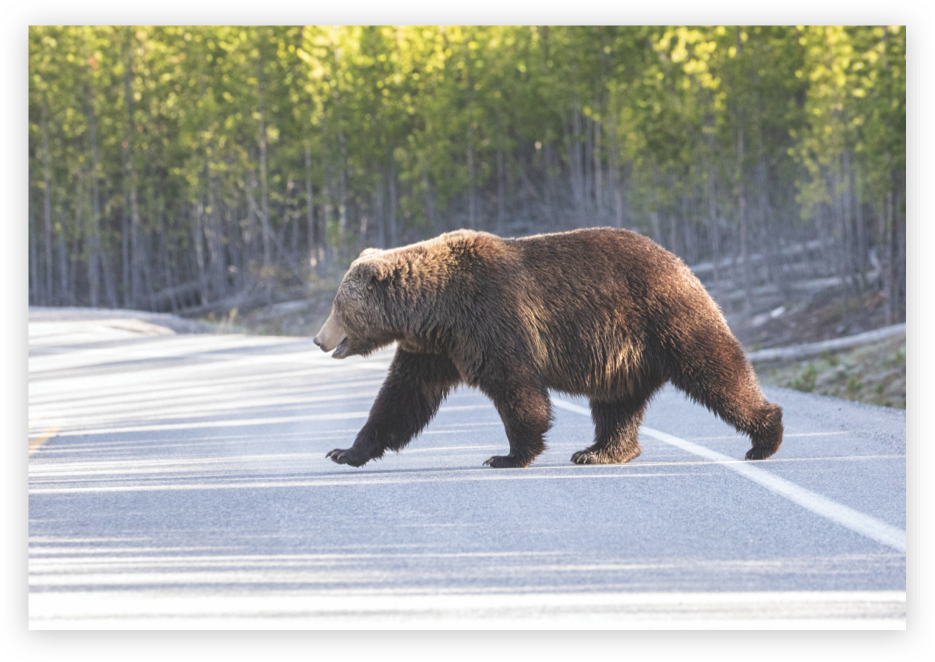
Grizzly bear crossing road | PHOTO COURTESY OF NPS / JIM PEACO
Coordinating Recovery
Thus, the creation of the IGBC in 1983, a coalition that encompasses any agency that deals with grizzlies. On the federal level, that includes the National Park Service, National Forest Service, Bureau of Land Management, and U.S. Geological Survey; state wildlife agencies from Montana, Wyoming, Idaho, and Washington, plus tribal nations in those states, round out the group. Five regional subcommittees, plus an executive committee and one dedicated to education and outreach, meet regularly to share grizzly population numbers, best practices, and emerging challenges. “We’re sitting down at a table with all the agencies involved, looking at what works best for bears and people into the future,” says Dan Thompson with the Wyoming Game and Fish Department.
“There’s a lot of expertise manifest in a lot of people, and in different agencies,” says Quentin Kujala, chief of conservation policy at Montana Fish, Wildlife & Parks. “The IGBC brings all that together in thoughtful discussion and debate.” Thanks to IGBC coordination, stakeholders decide what actions should be priorities and keep all parties up to date on management techniques. For example, IGBC experts make sure members are using the best available science to estimate grizzly bear numbers. The IGBC also helps agencies agree on an overall conservation strategy. “It’s very powerful to get in front of the public and have unanimous support from land management agencies and tribal partners, that this is our path to move forward,” Thompson says.
As of 2023, the USFWS estimates there are at least 2,314 grizzlies in the Lower 48 states. The IGBC continues to lead agencies in recovering the bear enough to delist it from the Endangered Species Act. “I don’t know how [recovering the grizzly] could be possible without the IGBC, given all the pieces out there that have to be reconciled,” Kujala says. “Without that coordination and communication, it suddenly becomes very difficult.”
Keeping Bears Wild
Plenty of backcountry food canisters, campground lockers, coolers, and garbage cans claim to keep out bears. But how do you know if they really work? Well, if the item is on the IGBC’s official list of bear-resistant products, then an actual grizzly bear tried—and failed—to get into it.
The grizzlies at the Grizzly and Wolf Discovery Center in West Yellowstone, Montana, serve as the IGBC’s busiest product testers (Washington State University also runs some tests). Manufacturers send their products to the nonprofit wildlife center—as many as 60 different ones come through in a year—where employees bait them with fish, honey, peanut butter, and sometimes, roadkill. Then, they place the product in the bear habitat to see what happens. If an item survives an hour of “paws-on” contact with the bears, then it earns the IGBC’s seal of approval. Only about half of tested products make the cut.
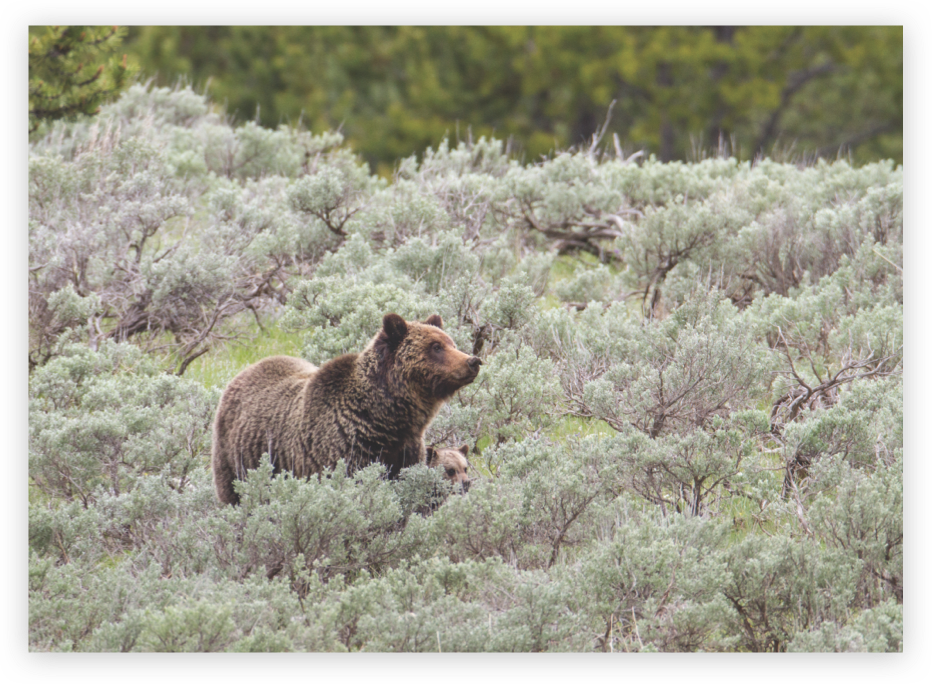
Grizzly sow and cub | PHOTO COURTESY OF NPS / JIM PEACO
For a smaller item, like a cooler or bear canister, grizzlies will often try what testing program manager Chris Wiese calls the CPR Method: “They stand on their hind legs and pounce on it with their two front paws like they’re doing CPR.” Many a lid will pop right off. That kind of brute force works for all kinds of items. The center once tested a birdfeeder that sat atop a high pole anchored in a four-foot-deep concrete base. Within half an hour, the tester grizzly dug the concrete out of the ground, ripped down the pole, and bent the birdfeeder’s metal bars to get at the birdseed.
Other times, the bears outsmart the gear. One grizzly, Kobuk, earned the nickname “The Destroyer” for his container-busting prowess. He would analyze the products,” Wiese says. “He would study latches, putting his eyes up to them, and then turn them at an angle so his claws could work like fingers.
He laughs, “Kobuk broke a lot of hearts.”
Testing happens during visiting hours, so the public can watch the bears put items through their paces. “It’s very entertaining to watch, but it serves a really valuable purpose,” Wiese says. “It’s so that wild bears aren’t being taken out of the population due to unsecured food. It’s keeping bears wild, and keeping people and bears safe.”
Managing New Habitat
As grizzly populations continue to rebound in the northern Rockies, bears are expanding into places they haven’t been regularly spotted in a long time. Suddenly, people in some Western towns need to get used to the idea of sharing habitat with grizzlies, whether that means taking steps to secure garbage and grain or remembering to grab bear spray on the local trails. That’s where the IGBC’s Bear Smart Communities program comes in.
Within the last few years, people had been seeing grizzly bears more frequently in and around the rural town of Choteau, Montana. Several people had even been injured in bear attacks after surprise encounters. So, Ali Morgan and her friend Anne Carlson decided to do something to prevent more grizzly-human conflict. Morgan, then a grizzly bear management technician with Montana Fish, Wildlife & Parks, turned to the IGBC’s website for advice on setting up a Bear Smart program. “Their framework makes it significantly easier to get things started,” she says. “[That was] super-important.”
Morgan and Carlson launched Teton Bear Smart in 2023. Besides supplying the group with educational materials and tips, IGBC also issued them several grants totaling $7,500. Teton Bear Smart used the money to start a fruit gleaning program, put on school outreach events, and most prominently, hold an annual Bear Fair. Last year, the event attracted 100 people (in a town of about 1,700), who practiced using bear spray with inert canisters, then took home a free can of bear spray. “I like my community, and I like wildlife,” Morgan says. “We want to mitigate any potential problems bears could get into.”